Best DSAR Redaction Tools in 2026: What to Look For
By Robert Healey, CEO, Formiti Data International
Last updated:
How to choose a DSAR redaction tool in 2026: six criteria, three approaches compared, and where redaction sits in the UK and EU GDPR request lifecycle.
Topics: DSAR, Document Redaction, Subject Access Requests, Buyer's Guide, UK GDPR
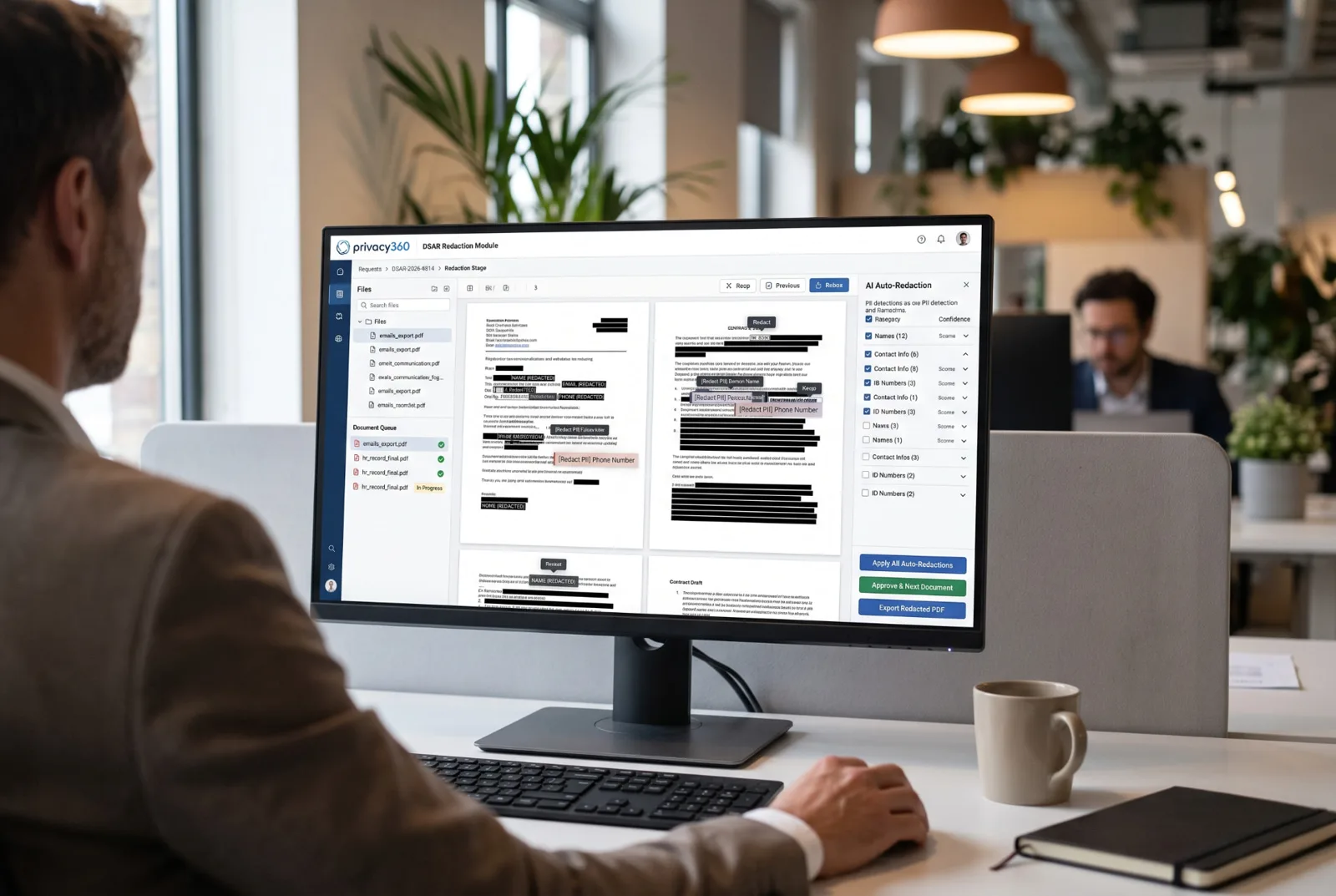
Putting this into practice? See how Privacy360's DSAR document redaction handles it. Redact PDF and Word documents inside the DSAR workflow, with suggestions a person approves.
Each redaction carries a reason. The final export is permanent and checked before release. As a result, the request, the documents and the disclosure decisions stay in one record. Originals also stay in your own region, so files do not travel to a third-party service.
This guide explains what to look for in a DSAR redaction tool. It then compares the three common approaches and shows where redaction sits in the request lifecycle.
What should a DSAR redaction tool do?
A good tool removes third-party data and exempt material accurately, and it proves what it did. Six criteria separate a strong tool from a weak one.
- Human approval. The tool may suggest redactions. However, a named person should approve each one.
- A reason for every redaction. A reviewer should record why data was removed. Consequently, you can explain the decision to the requester or a regulator.
- Permanent output. Visual black boxes are not enough. The exported file must not hide recoverable text underneath.
- A check before release. The export should be verified, so the wrong version is not sent.
- Common formats. PDF and Word cover most DSAR disclosure bundles.
- One audit trail. Redaction history should sit with the request, not in a separate system.
Finally, ask where the files go. A tool that needs an export to another service adds a processor, a contract and possibly a transfer question.
How do the three main approaches compare?
In-platform redaction keeps the request, documents and evidence together. Other approaches vary by product, so check each one against the criteria above.
| Criterion | In-platform (Privacy360) | Bolt-on tool | Standalone cloud service |
|---|---|---|---|
| Files leave the DSAR platform | No | Usually, files are exported first | Yes, files are uploaded |
| Extra processor and DPA | No separate redaction vendor | Often needed | Often needed |
| International transfer review | Originals stay in your own region | Depends on the tool | May be needed if processed abroad |
| Document versions | One version in the request record | Copies multiply | Copies multiply |
| Audit trail | Redaction history sits with the request | Held apart from the request | Held apart from the request |
| Return of redacted files | Automatic, inside the workflow | Manual re-upload | Manual re-upload |
The table describes how each approach usually works. It does not rate any named product.
How does Privacy360 Document Redaction work?
The module runs inside the Privacy360 DSAR module. A reviewer works through each document in four moves.
- Open the document. Upload or attach the PDF or Word file to the request.
- Review suggestions. The tool proposes personal data for removal. Nothing is redacted until a person approves it.
- Record the reason. Each redaction carries a stated reason, such as third-party data or an exemption.
- Export. The output is permanent and checked before release.
Because every step happens in one place, reviewers see a single version of each document. The audit trail also stays complete. See the Document Redaction module, or browse all Privacy360 tools on the modules page.
Formiti's outsourced DPO clients get Privacy360 at no extra charge.
Where does redaction fit in the DSAR lifecycle?
Redaction belongs inside the request, not after it. In Privacy360, a DSAR moves through eight steps in one record.
- Intake
- Identity verification
- Data collection
- Review
- Redaction
- Exemptions log
- Disclosure
- Closure
Redaction sits between review and disclosure. Therefore, the exemptions log records why each item was withheld before anything is sent. Learn more about the DSAR automation module and DSAR workflow software.
Which legal rules shape DSAR redaction?
The rules set the clock and limit what you may withhold. Redaction tools must work inside both.
Time limit. Under the UK GDPR, the ICO says you must respond without undue delay and within one month of receipt. You may extend by up to two further months if the request is complex or the person made several requests. You must tell the person within the first month and explain why. The EU position is the same: the EDPB guidelines on the right of access describe one month, extendable by two months.
The clock can start later. The ICO explains that the month runs from receipt of the request, or from receipt of ID or fee information you asked for. See the ICO guidance on subject access requests.
Exemptions. Not every document must be disclosed in full. The ICO lists the exemptions relevant to SARs. Consequently, a reviewer should record which exemption applies to each redaction.
Other people's data. The right to a copy must not adversely affect the rights and freedoms of others. For that reason, third-party personal data is a common reason to redact.
Formiti's team can help you apply these rules to live requests. See our outsourced DPO service.
Frequently asked questions
What is the best DSAR redaction tool?
The best tool redacts inside your DSAR workflow, needs human approval, records a reason for each redaction and exports permanently. Privacy360 Document Redaction is built this way for PDF and Word files.
Does Privacy360 redact automatically?
It suggests personal data for removal. However, a person approves every redaction before export.
Do documents leave the platform?
No. Redaction happens inside Privacy360. Originals stay private, in your own region.
Why not use a separate redaction tool?
A separate tool can add a processor, a DPA, a transfer question and a split audit trail. In-platform redaction avoids those extra steps.
How long do we have to answer a DSAR?
Usually one month from receipt, extendable by up to two months for complex requests. The ICO and EDPB guidance give the detail.
Can I try it?
Yes. Book a Privacy360 demo or see the Document Redaction module.