ROPA Tool Versus Manual Tracking
By Formiti Global DPO Team, Formiti Data International
Spreadsheets can hold a ROPA, but should they? A practical comparison of ROPA tools and manual tracking for privacy and AI oversight.
Topics: ROPA, GDPR, Privacy Operations, AI Governance, Vendor Risk
Putting this into practice? See how Privacy360's ROPA software handles it. Keep an Article 30 record of processing with owners, data maps and processor links.
If your Record of Processing Activities still lives in a spreadsheet, you already know the problem is not whether the file exists. The problem is whether anyone trusts it. That is the real question in ropa tool versus manual tracking: not which format looks familiar, but which one gives legal, privacy and operational teams a current, defensible view of processing across the business.
For smaller organisations with limited processing activity, manual tracking can work for a time. A spreadsheet, shared document or internal register may be enough to gather basic GDPR Article 30 information and respond to simple internal queries. But once processing changes frequently, vendors multiply, business units operate across jurisdictions, and AI use cases begin to appear, manual tracking stops being a record and starts becoming a lagging approximation.
This is why the choice matters. ROPA is not a static compliance artefact. It is an operating record that underpins risk assessments, supplier reviews, incident response, data subject rights handling and management reporting. If the underlying record is fragmented or outdated, every downstream governance activity becomes slower and less reliable.
ROPA tool versus manual tracking: what actually changes?
The practical difference is not just automation. It is control.
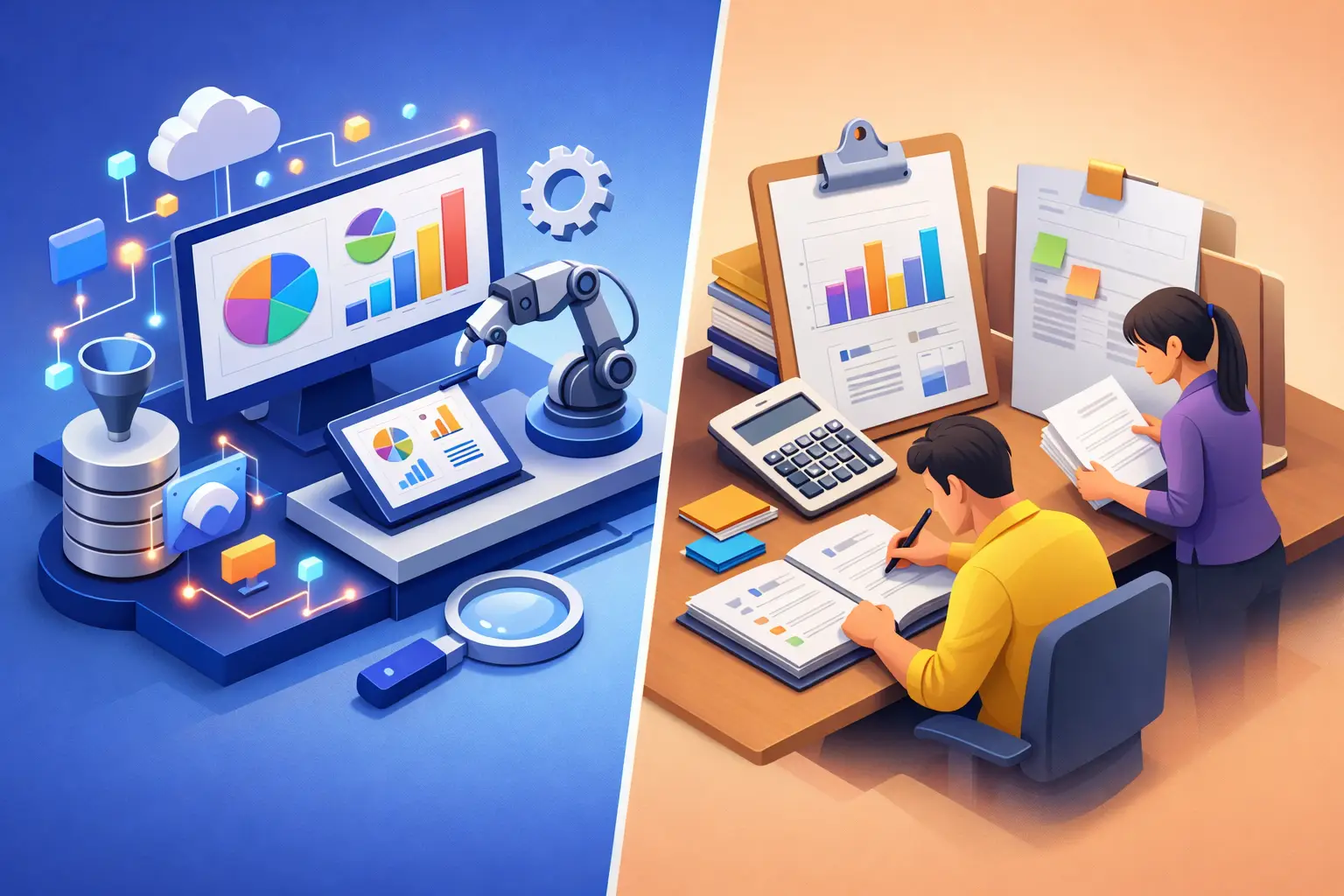
Manual tracking usually means information is captured in disconnected formats, updated by different people, and reviewed on an inconsistent cycle. Ownership can be vague. Version history is often incomplete. Evidence may sit in inboxes, calls, meeting notes or separate systems. In that model, the ROPA depends heavily on individual follow-through.
A dedicated ROPA tool changes the operating model. Processing records are structured, fields are standardised, ownership is assigned, and updates can be built into repeatable workflows. Instead of asking each business unit to describe processing in its own way, the organisation creates one system for documenting purposes, legal bases, retention periods, categories of data, recipients, transfers and security measures.
That structure matters because privacy teams are rarely managing ROPA in isolation. They are coordinating with legal, procurement, security, HR, product and data owners. Manual methods struggle as soon as the record needs to support multiple stakeholders with different responsibilities and different timelines.
Where manual tracking still has a place
It is easy to overstate the case against spreadsheets. They are familiar, fast to start with and low-friction for early information gathering. For a lean team setting up an initial inventory, manual tracking may be a reasonable first step. It can also work where processing is stable, centralised and limited in scope.
The issue is durability. Manual tracking is often acceptable for creating a first draft of a ROPA, but much weaker as a long-term governance mechanism. As the programme matures, the effort required to maintain consistency rises sharply. What begins as a simple register turns into an administrative burden spread across privacy leads, business contacts and reviewers.
There is also a hidden cost. Spreadsheets appear inexpensive because the software is already there. But time spent chasing updates, checking completeness, reconciling versions and preparing for audits is still operational spend. It is just dispersed across teams and therefore easy to underestimate.
The operational weaknesses of manual ROPA management
The main problem with manual tracking is not that people are careless. It is that the process relies on too many manual controls.
A privacy team may send out quarterly update requests, but business units respond in different formats or not at all. A vendor changes sub-processors, but that update never reaches the central record. A new AI-enabled workflow is launched by a product team, yet the legal basis, data categories and transfer details are documented later, if at all. In each case, the record falls behind the business.
Manual tracking also creates difficulty around accountability. Who approved a change? When was a retention period updated? Which records have not been reviewed in twelve months? Which processing activities require a DPIA, a Legitimate Interest Assessment or a vendor reassessment? Spreadsheets can capture fields, but they do not naturally enforce process discipline.
That becomes more serious in regulated environments. When an auditor, regulator or internal governance committee asks how records are maintained, an organisation needs more than a file. It needs a clear method for ownership, review, evidence and change management.
What a ROPA tool does better
A strong ROPA tool does not simply replace rows and columns with a nicer interface. It creates a controlled environment for maintaining processing records as live governance data.
The first benefit is standardisation. Required data points are captured consistently across business units, which improves comparability and reporting. The second is workflow. Reviews, attestations and escalations can be assigned and tracked rather than chased informally. The third is traceability. Changes are recorded, owners are visible and the status of each processing activity is easier to verify.
That has a direct effect on audit readiness. When records are centralised and current, privacy teams can answer basic questions quickly: what processing is taking place, who owns it, what lawful basis applies, where data goes, which suppliers are involved, and whether associated assessments have been completed.
This is where an operational platform has broader value. If ROPA sits alongside DPIA workflows, DSAR management, breach and incident management, vendor risk assessment, contract review and AI system oversight, the organisation reduces duplication. Teams stop re-entering the same facts into disconnected tools and can manage governance as one coordinated process.
ROPA tool versus manual tracking in complex organisations
The larger and more distributed the organisation, the less convincing manual tracking becomes.
A single-market business with one privacy lead and limited processing complexity has different needs from a multinational organisation handling employee data, customer data, supplier data and AI-enabled decision support across multiple functions. In the second case, the ROPA needs to do more than satisfy an Article 30 obligation. It needs to support programme management.
Cross-jurisdictional operations increase that pressure. UK GDPR, GDPR, Swiss nFADP and local privacy regimes may not require entirely different records, but they do create different reporting expectations, transfer considerations and stakeholder demands. Manual tracking makes harmonisation harder because every update becomes a coordination task.
The same applies to third parties. Once supplier ecosystems grow, processing records need to reflect processor relationships, transfer paths, contractual controls and review status. Keeping that current manually is possible, but it is slow and dependent on disciplined human follow-up. Most organisations do not fail because they lack intent. They fail because fragmented operating methods do not scale.
AI governance makes the gap wider
For organisations adopting AI, the gap between manual tracking and a structured ROPA tool becomes wider still.
AI use cases often involve changing data flows, model inputs, vendor dependencies and risk profiles. If privacy and AI governance are handled separately, teams can end up documenting the same system in multiple places with inconsistent detail. That weakens oversight. A processing record should not sit apart from the organisation's understanding of where AI is used, what data it relies on and whether additional assessment is required.
A unified platform approach helps here because it connects processing records with AI system inventory, risk classification and supporting evidence. That does not remove the need for legal and governance judgement, but it does make the operating record far more usable.
When the business case becomes obvious
The business case for moving away from manual tracking usually appears before the spreadsheet fully breaks.
It shows up when ROPA updates take weeks rather than days, when internal stakeholders provide conflicting answers, when privacy reviews start from scratch because prior records cannot be trusted, or when audit preparation becomes a document reconstruction exercise. It also shows up when lean teams spend their time administering records instead of managing risk.
At that point, the decision is no longer about convenience. It is about whether the organisation wants governance data that can support execution.
Privacy360 reflects this operational shift by placing ROPA within one structured environment alongside DPIA, LIA, DSAR workflow automation, breach management, contract review, vendor assessment and AI system governance. For teams trying to reduce fragmentation, that matters more than adding another standalone register.
The right answer depends on scale and accountability needs
There is no need to pretend every organisation requires a full platform on day one. If your processing landscape is simple and stable, manual tracking may still be adequate for a period. But adequate is not the same as resilient.
As soon as privacy obligations become cross-functional, evidence-led and subject to ongoing change, the limitations of manual methods become expensive. A ROPA tool is not just a faster way to store records. It is a more reliable way to maintain accountability across the business.
That is the real dividing line in ropa tool versus manual tracking. One approach documents processing. The other helps govern it. For organisations that need repeatable control, current records and a stronger operational footing for privacy and AI oversight, that distinction becomes hard to ignore.
The better question, then, is not whether a spreadsheet can hold a ROPA. It is whether your governance model can still rely on one.