Privacy Workflow Automation vs Point Tools
By Formiti Global DPO Team, Formiti Data International
Privacy workflow automation vs point tools: how unified workflows for DPIA, DSAR, ROPA, vendor and AI governance beat fragmented point solutions.
Topics: Privacy Operations, Workflow Automation, DPIA, DSAR, AI Governance
Putting this into practice? See how Privacy360's DSAR automation software handles it. Take in, verify, route and fulfil data subject requests on time with a defensible audit trail.
A privacy team can manage a handful of assessments in spreadsheets and email. The model breaks down when requests multiply, regulators expect evidence on demand, and AI oversight joins an already crowded governance agenda. That is where privacy workflow automation vs point tools stops being a software debate and becomes an operating model decision.
For most mid-market and enterprise organisations, the issue is not whether a point solution can perform a single task well. Many can. The real question is whether separate tools, trackers and inbox-driven processes can support a repeatable, auditable governance programme across DPIAs, DSARs, ROPA, incidents, vendor reviews, contract workflows and AI system oversight.
What privacy workflow automation vs point tools really means
Point tools solve one problem at a time. You might have one tool for DSAR intake, another for vendor questionnaires, a shared drive for evidence, spreadsheets for ROPA, and manual templates for DPIAs and LIAs. Each component may look effective in isolation. Across the programme, however, ownership fragments quickly.
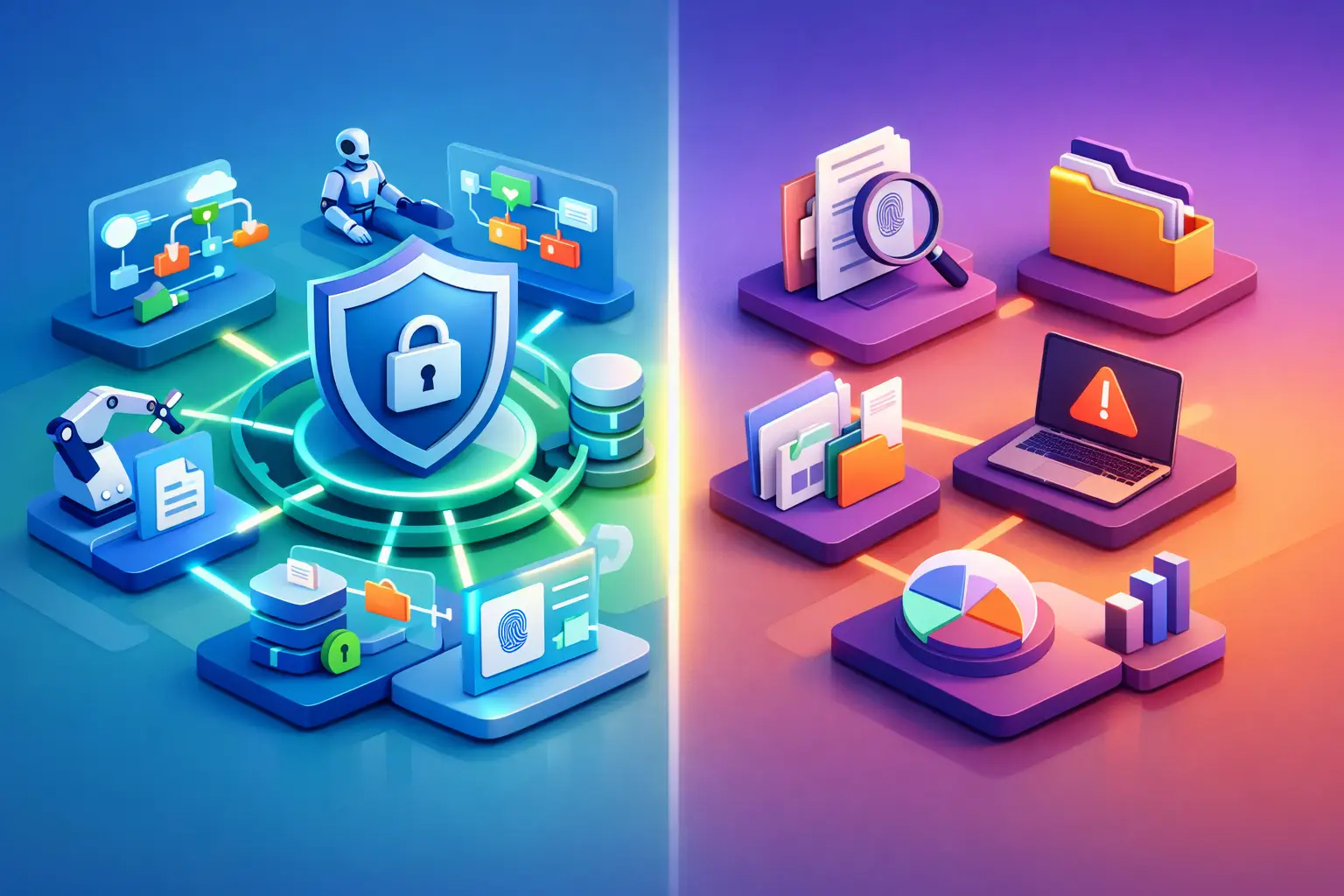
Privacy workflow automation takes a different approach. It treats governance as a connected system of recurring workflows with dependencies, approvals, evidence requirements and reporting needs. Instead of asking whether each team has a tool, it asks whether the organisation can run privacy and AI governance through one controlled environment.
That distinction matters because privacy operations rarely stay within one function. Legal reviews contract clauses. Security contributes to incidents. Procurement owns supplier engagement. Product teams trigger assessments. Risk and compliance need reporting. When each group works in a different system, coordination becomes manual. Manual coordination is where delays, inconsistency and missing records tend to appear.
Where point tools start to create operational drag
Point tools often enter the business for sensible reasons. A team has an urgent need, limited budget or a narrow compliance gap to close. In that context, a focused application can look faster to deploy than a broader operating platform.
The problem appears over time. As obligations expand across jurisdictions and AI governance enters the picture, the team inherits multiple systems that do not share context. A vendor review may trigger a DPIA. A DPIA may identify a contract issue. An incident may require updates to records, notifications and evidence logs. If each step sits in a separate location, the programme depends on people remembering what to do next.
That creates familiar friction. Data is duplicated. Fields are defined differently. Evidence lives in email threads. Status reporting becomes a manual exercise before every steering meeting or audit request. Teams spend time reconciling records rather than managing risk.
Point tools also make accountability harder to maintain. If no single system shows who initiated, reviewed, approved and completed each governance task, programme leaders have limited operational visibility. They may know policies exist, but not whether processes are being followed consistently.
Why workflow automation changes the operating model
Workflow automation is not only about speed. In a governance context, its value is structure. A well-designed workflow sets triggers, required steps, review paths, owners, timestamps and evidence capture as part of the process itself.
For example, a DPIA should not simply be a form. It should route to the right reviewers, capture decisions, record residual risk, and preserve an audit trail. A DSAR process should not depend on inbox monitoring and handoffs in chat. It should assign actions, track deadlines and maintain defensible records. Vendor assessments should connect to processing activities, contract review and, where relevant, AI system use.
This is where a unified platform approach becomes materially stronger than a collection of point tools. Privacy work is interconnected. Automation makes those connections operational rather than aspirational.
In practice, that means teams can run DPIA and Data Protection Impact Assessment workflows, Legitimate Interest Assessments, DSAR management and workflow automation, ROPA maintenance, breach and incident management, contract review and DPA redlining, vendor risk assessment, and AI system registry with EU AI Act risk classification within one system. The result is not just fewer logins. It is better control over how decisions are made and evidenced.
Privacy workflow automation vs point tools in complex environments
The bigger and more regulated the organisation, the less useful a narrow-tool strategy becomes. Global organisations do not only need task completion. They need consistency across jurisdictions, business units and lines of defence.
A point tool may support one process well but still leave gaps between privacy, legal, security and procurement. Those gaps matter when governance leaders are asked simple but high-stakes questions. Which systems involve high-risk processing? Which suppliers support those systems? Which contracts contain the right clauses? Which incidents affected regulated data? Which AI use cases have been classified under the EU AI Act framework? Which actions remain overdue?
If the answers live in different places, reporting becomes slow and confidence drops. If the answers sit in one operational layer, leaders can manage by exception rather than by chasing updates.
This is also where audit readiness improves. Auditors and internal stakeholders do not want a narrative about how the process should work. They want evidence of what happened, when it happened and who approved it. Workflow automation creates that record as a by-product of execution.
The trade-offs are real
There are cases where point tools still make sense. If an organisation has a highly mature governance stack, strong internal integration capability and a genuinely narrow requirement, a focused tool can be practical. Some teams also prefer phased change rather than platform consolidation in one step.
But the trade-off should be understood clearly. Every additional tool introduces another boundary in ownership, another reporting layer and another data model to maintain. The cost is not always visible in licence fees. It shows up in slower coordination, duplicated administration and inconsistent evidence.
A unified workflow model also requires discipline. Standardised processes can expose where teams have been relying on informal workarounds. That is usually a positive change, but it does require operational buy-in. The right question is not whether automation eliminates effort. It is whether the effort goes into governance execution or into stitching fragmented processes together.
What to evaluate before choosing a model
The strongest buying decisions start with operational design, not feature checklists. If you are weighing privacy workflow automation vs point tools, assess how your programme actually runs across teams.
Look first at workflow dependency. If your privacy obligations regularly move between legal, security, procurement, product and compliance, disconnected tools will almost certainly create friction. Then look at evidence. If your team spends significant time preparing audit packs, board updates or regulatory responses manually, your current model is not producing the records you need.
Next, examine process volume and repeatability. A low-volume environment can tolerate more manual handling. A higher-volume programme with recurring assessments, rights requests, supplier reviews and AI governance activity usually cannot. Finally, consider whether privacy and AI governance are converging in your organisation. If they are, adding separate tooling for each new control area tends to recreate the same fragmentation under a different label.
This is why many governance leaders now favour one operational system rather than a patchwork of forms, trackers and specialist apps. The benefit is not software consolidation for its own sake. It is a more reliable control environment. Where organisations need external support to design that operating model or run a target-state assessment, Formiti's consulting services provide privacy operations advisory, DPO-as-a-Service and cross-jurisdiction compliance expertise alongside platform deployment.
The strategic case for one operational system
Privacy programmes are under pressure to do more than document compliance. They need to show control, accountability and execution quality across a growing set of obligations. AI governance raises the bar further because oversight requirements now extend beyond traditional data protection workflows.
That makes system design a governance issue. If privacy and AI processes are managed through disconnected tools, the organisation may still complete individual tasks, but it will struggle to maintain a coherent operating picture. If those workflows sit within one structured environment, programme leaders can standardise decisions, monitor throughput, surface exceptions and preserve evidence without rebuilding the process every quarter.
For organisations operating across multiple jurisdictions, this matters even more. Regulatory nuance will always exist, but the underlying need is stable: consistent workflows, clear accountability and records that stand up to scrutiny. A unified approach supports that foundation better than a loose set of point solutions.
Privacy360 reflects this operating model by bringing privacy and AI governance into one environment built around repeatable workflows rather than disconnected task handling. That alignment matters for teams that need operational control, not just another system to administer.
The most useful question is not which tool has the longest feature list. It is whether your governance model can still hold together when case volume rises, regulators ask for evidence, suppliers multiply and AI enters production. If the answer depends on spreadsheets, inboxes and individual memory, the operating model has already given you the answer.