Mastering the Principle of Least Privilege: A Practical 2026 Guide to Modern Identity Security
By Formiti Global DPO Team, Formiti Data International
Learn how to apply the principle of least privilege in 2026. Protect your systems by granting only the minimum access necessary for every user and device.
Topics: Access Control, Identity Security, GDPR, AI Governance, Zero Trust
Putting this into practice? See how Privacy360's AI governance software handles it. Govern AI systems end to end: register, assess, remediate and evidence under the EU AI Act.
Understanding the Principle of Least Privilege (PoLP) in 2026
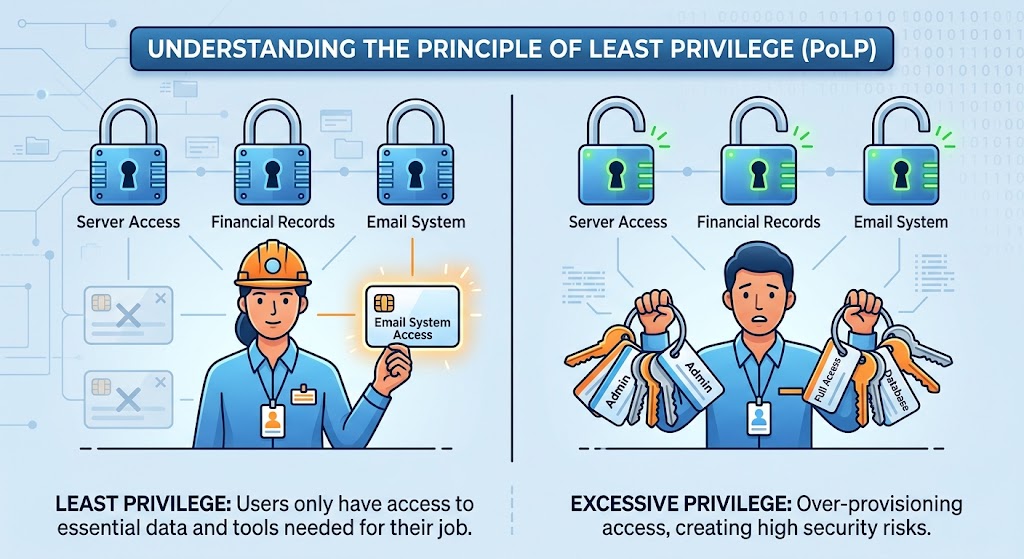
If you're accountable for systems you can't personally watch every hour, this is the control that does the most work for you. To define least privilege simply: every user, process, service account, and device receives only the access needed to complete a specific task, for only as long as the task takes. Nothing more, nothing less.
This is the "need-to-know" basis, and it's the opposite of handing someone broad administrative rights because it's faster. The concept of least privilege — sometimes called the principle of least authority — supports all five foundational security goals: confidentiality, integrity, availability, accountability, and assurance. It's also the engine inside Zero Trust Architecture, since least privilege cybersecurity is what "verify, then grant narrowly" actually means in operation.
The Core Mechanics: How PoLP Functions in Modern Systems
Processor design has modelled this for decades: Ring 0 code touches the kernel, Ring 3 code runs with minimum privilege and must ask. Modern identity management works the same way. Permanent entitlements are replaced by Just-in-Time elevation — access granted on request, expiring automatically. Without automated revocation, least privilege permissions can quietly accumulate into privilege creep, where yesterday's project access becomes today's unmonitored backdoor.
PoLP in Regulatory Frameworks: NIST 800-53 and Beyond
Regulators now expect the least permissions principle to be documented, not assumed.
- NIST 800-53 AC-6 requires organisations to authorise only the access necessary for assigned duties, and to review those authorisations periodically.
- GDPR and the EU AI Act treat access control as evidence of data minimisation and accountability — NIST least privilege practices map cleanly onto both.
- User accounts versus service accounts need separate restriction logic; audit-ready environments document each independently.
The Strategic Value: Why Least Privilege is Non-Negotiable
When credentials are compromised — and they will be — the damage is bounded by what those credentials could reach. Least privilege access shrinks the blast radius from "the estate" to "one application, one dataset, one window of time."
It also breaks lateral movement. Flattened networks let an attacker pivot from a low-value foothold toward domain controllers and data stores. The rule of least privilege eliminates these stepping stones.
The operational gains are just as real. Tightly scoped roles reduce accidental deletions and misconfigurations by people acting in good faith. And when an auditor asks who could access a regulated dataset last quarter, organisations that enforce least privilege answer with a report instead of a three-week investigation.
Mitigating Insider Threats and Malware Propagation
Malware inherits the rights of whatever executed it. Under a least privilege model, ransomware landing on a standard workstation can't rewrite system files or reach shared drives it was never granted. Endpoint least privilege can turn a potential estate-wide event into a contained one. The same scoping limits what a disgruntled or compromised insider can export. Default Deny asks you to justify access; Default Allow asks an attacker for nothing.
Practical Application: PoLP in Action Across the Enterprise
A clear least privilege example: a backup service account that can write new objects but cannot delete or modify existing ones, so compromised credentials can't destroy the recovery path. A marketing specialist publishes through the CMS but holds no database credentials. Privilege bracketing applies the minimum access principle to time itself — finance elevation that exists only during the close window, then expires.
Implementation Roadmap: From Excessive Access to Least Privilege
Most organisations don't start from zero; they start from years of accumulated entitlements nobody wants to touch. Begin with discovery. Export current permissions across directory services, cloud platforms, SaaS applications, and databases, then compare granted rights against actual usage telemetry. Unused entitlements are your first removals — low risk, immediate reduction.
Next, rank high-value targets: domain admins, cloud root and global administrator accounts, privileged database roles, and any identity with access to regulated personal data. These get remediated first, because they carry the most consequence.
Then shift the model itself. Applying least privilege at scale means retiring standing privileges in favour of ephemeral, request-based elevation with automatic expiry. Cloud least privilege depends on this, since cloud entitlements multiply faster than any manual review cycle can track.
Step-by-Step Transition Strategy
- Audit: Identify over-provisioned users, orphaned "ghost" accounts, and dormant service identities.
- Structure: Implement RBAC least privilege by grouping permissions around functional necessity, then validate each role with the business owner who understands the work.
- Monitor: Log every elevation and denied request. IAM least privilege programmes improve fastest when you can see where people grant least privilege by exception.
Common Failure Modes: Why PoLP Projects Often Stall
Three patterns stall these programmes. Workflow friction, where controls block urgent work and teams route around them. Exception sprawl, where "temporary" grants never expire and the exception register becomes the real access model. And incomplete discovery of non-human identities — bots, service accounts, CI/CD pipelines, and API keys — which usually outnumber employees and rarely appear in least privilege management reviews.
The Trade-offs: Balancing Strict Security with Operational Agility
It's fair to acknowledge the cost. Mapping roles, interviewing process owners, and classifying entitlements require real administrative effort before benefits are seen. That initial overhead is the honest price of the least possible privilege posture.
Emergency access needs deliberate design too. Break-glass accounts must exist for the incident at 3 a.m. when strict IT least privilege blocks the fix — vaulted, heavily monitored, alerting on use, and rotated afterwards.
The cultural shift is the hardest part. Engineers and power users accustomed to permanent local admin on Windows least privilege rollouts will feel demoted. Explain the reasoning, offer fast self-service elevation, and measure approval turnaround. Friction that's answered in minutes gets accepted; friction that's answered in days gets circumvented.
When PoLP Isn't Enough: Layering Defensive Strategies
Narrow permissions assigned to a stolen identity still belong to the attacker. Pair the least security principle with phishing-resistant MFA so the identity itself is harder to borrow. Social engineering can also target exactly the modest access a role legitimately holds. Regular attestation cycles — where managers re-verify that each grant is still required — ensure security least access remains honest over time.
Comparison: RBAC vs. ABAC in a Least Privilege Model
RBAC suits stable, predictable structures where job functions map neatly to permission sets, and it's the pragmatic starting point for most teams applying the least rights principle. ABAC evaluates context at request time — device health, location, data classification, time of day — and fits dynamic, multi-entity environments. Larger estates often run both: RBAC for the baseline, ABAC conditions for sensitive operations.
Frequently Asked Questions About PoLP
Which best describes the principle of least privilege? Granting each identity the minimum rights required for its assigned task, and revoking them when the task ends.
How do you apply it to cloud environments? Start with identity policies rather than network position. AWS least privilege work usually means replacing wildcard IAM actions with scoped, resource-specific permissions; Microsoft least privilege work centres on eliminating standing global administrator roles. OWASP least privilege guidance extends the same thinking to application authorisation logic.
Is this only an IT administrator concern? No. The less privilege principle applies to every account — contractors, analysts, vendors, applications, and automated agents. Administrators are simply the highest-consequence starting point.
Is PoLP the same as Zero Trust?
They're related, not identical. The principle least privilege governs what an authenticated identity may do; Zero Trust is the broader architecture covering identity, device posture, network segmentation, and continuous verification. The shift is from "trust but verify" — where location implied trust — to "never trust, always verify," where every request is evaluated on its merits.
Does least privilege apply to IoT and AI models?
Increasingly, it's where the risk concentrates. An AI agent should hold least necessary privilege on its API credentials, so a successful prompt injection can read a scoped dataset but not write to core databases. IoT devices belong on segmented networks with minimal egress rights. Document both in your AI System Register.
Key Takeaways: Securing the Future of Identity
Minimalism is the strategy. Limiting what each entity can reach is the single most reliable way to cap the impact of a breach you didn't prevent.
At enterprise scale, that's only sustainable through automation — Just-in-Time elevation, automatic expiry, and continuous entitlement review rather than annual spreadsheets. Manual least privilege software reviews can't keep pace with cloud and AI identity growth.
Cybersecurity least privilege is now a compliance artefact as much as a control. Firewall least privilege rules, access logs, and attestation records are the evidence that satisfies auditors under GDPR and the EU AI Act.
Privacy360 brings that evidence into one audit-ready command centre, connecting access governance to privacy assessments and DPIAs, vendor risk, and AI oversight. Book a demo to see how it maps to your estate.
Where to Look Next
Work from primary sources. Consult NIST publications and official government cybersecurity guidance for control-level detail on access enforcement. Review ISO/IEC 27001 for management-system context around access governance. Academic texts on operating system architecture explain the hardware roots of least privilege. Then review Privacy360's module catalogue for the operational layer.