Why the Group DPO Needs a Single View of Global Privacy Compliance
By Robert Healey, CEO, Formiti Data International
Last updated:
Why Group DPOs need a single view of global privacy compliance to manage multi-entity risk, prioritise remediation and keep oversight of every entity.
Topics: Group DPO, Multi-Entity Compliance, Natalie Pathway, Privacy Governance, Remediation
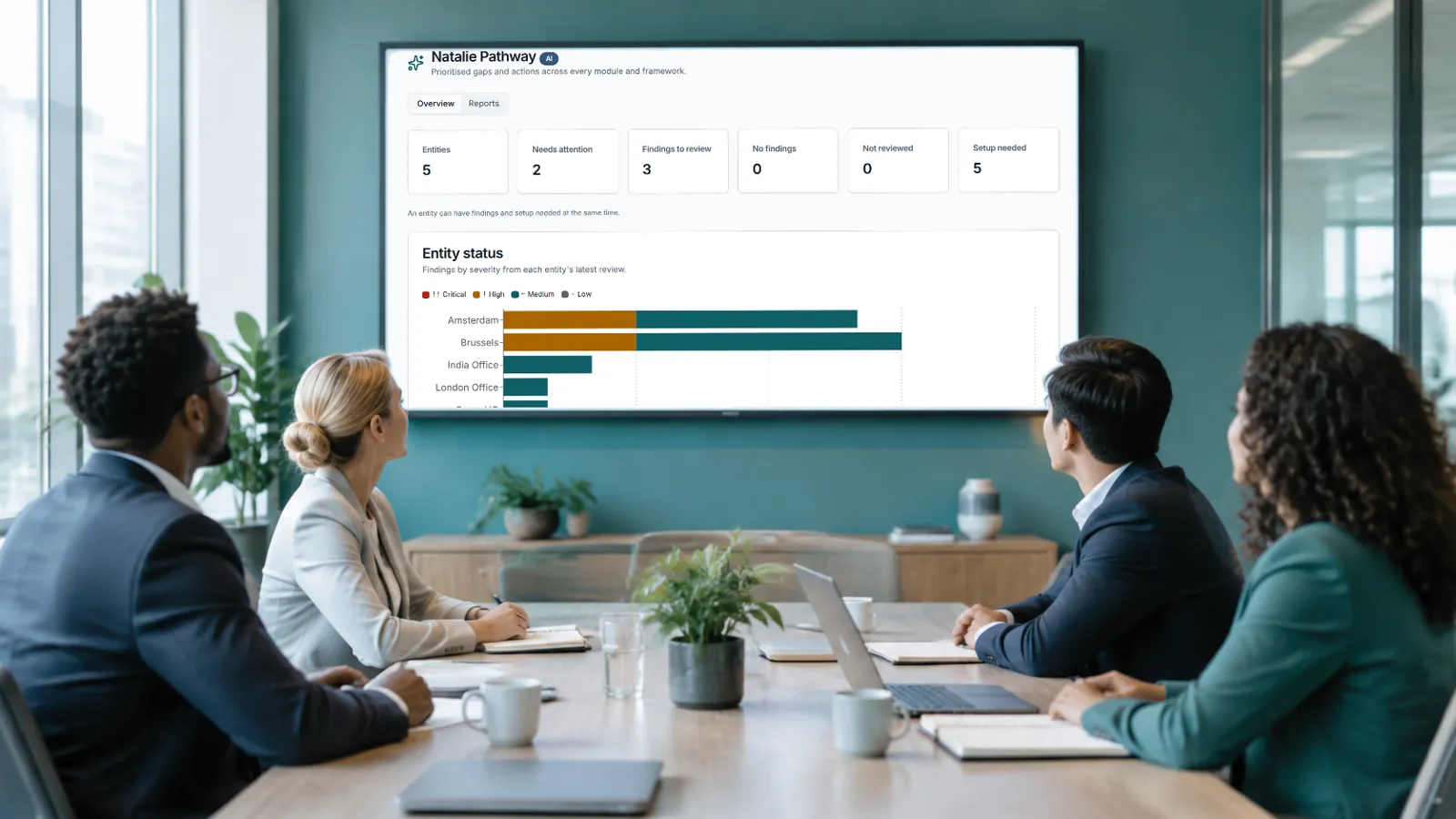
Putting this into practice? See how Privacy360's Natalie Pathway, the Privacy360 Intelligence Centre handles it. See each entity's privacy status, findings by severity and review coverage in one view, included in all plans.
The Visibility Gap in Global Privacy Governance
A Group DPO often signs off on a group-wide compliance statement with only a partial picture. The Spanish subsidiary last updated its records of processing eighteen months ago. The Singapore entity ran a DPIA that nobody at group level has read. A newly acquired business in Brazil has never submitted anything at all. None of these gaps announce themselves. They surface during a regulator's enquiry, or after a breach, when the question becomes: who knew, and when?
Corporate complexity hides local risk. Each legal entity runs its own systems, vendors and local counsel, and each reports upward in a different format and on a different cycle. Spreadsheets circulated by email cannot reconcile that. By the time the data is consolidated, it describes a state of affairs that no longer exists.
Regulatory pressure is increasing. Data protection complaints to the UK ICO rose to 76,743 in 2025/26, up from 42,315 the year before.
Manual oversight struggles to manage that volume across multiple jurisdictions. Group DPO compliance oversight now depends on seeing entity-level status continuously, not quarterly.
That is the function of a Single View: one command centre where every entity's status, every open finding and every affected record is visible at once. Privacy360's Natalie Pathway gives group DPOs exactly that — entity-by-entity status, findings by severity, review coverage and the precise affected records, such as ROPA-001. Defined Privacy360 rules produce the figures; AI only explains the results and recommends next steps.
Defining the Unified Compliance View for Group Entities
"Single View" is often used loosely. For a Group DPO it has a precise meaning: every entity's live compliance state, expressed in the same vocabulary, refreshed as work happens rather than when a reporting cycle closes.
A privacy compliance dashboard built for multi-entity privacy management should surface:
- Entity status — a plain-language state per legal entity. Privacy360's Natalie Pathway uses No findings, Findings to review, Needs attention and Not reviewed, plus an Out of date flag when a review has aged beyond its window.
- Findings by severity — open issues ranked so attention follows risk, not alphabetical order.
- Review coverage — which entities, processes and systems have actually been assessed, and which have not.
- Affected records — the exact ROPA entry, assessment or system behind each finding, named down to the record identifier.
- Basis of each finding — whether it rests on a legal obligation, regulator guidance, best practice, or simply setup still outstanding.
- Jurisdictional context — local requirements applied per entity rather than flattened into a single global rule set.
Two design decisions matter here. Privacy360 shows no single compliance score, because one aggregate number hides exactly the entity-level detail a Group DPO needs. And No findings does not certify legal compliance; it states that the configured checks found nothing, which is a different and more honest claim.
This is the structural break from the annual audit. A point-in-time review describes a moment that has already passed. Continuous entity status monitoring describes now. The difference shows in confidence: in a 2023 IAPP-EY survey, 70% of organisations with a DPO report confidence in their privacy compliance, against 30% of those without one.
Categorising Findings by Severity to Mitigate Global Risk
A list of 400 open findings across 30 entities creates noise, not oversight. Severity classification is what converts that list into a work queue. It also protects the Group DPO from alert fatigue, where everything is flagged and therefore nothing is acted on. Each finding should state its basis, so a severity rating is traceable to a legal obligation, regulator guidance, best practice or outstanding setup rather than to someone's judgement call.
High severity
Findings that expose the group to enforcement, individual harm or material contractual breach. These demand named owners and dated remediation within days.
- Special category data processed without a documented lawful basis
- Personal data transferred cross-border with no valid transfer mechanism
- A high-risk AI system in production without an EU AI Act classification or completed assessment
- Breach notification processes that cannot meet statutory deadlines
Medium severity
Gaps that do not create immediate exposure but will, if left, become high severity. They belong on a defined remediation schedule with group-level visibility.
- ROPA entries missing retention periods or recipient categories
- Vendor assessments completed but lacking supporting evidence
- DPIAs drafted and never formally signed off
Low severity
Administrative and hygiene items. They matter for audit-readiness and should be tracked, not escalated.
- Inconsistent naming across entity records
- Training records logged outside the central register
Scale explains the urgency. Reported personal data breaches in the UK rose from 12,412 to 17,431 in 2025/26. A mishandled high-severity finding in one subsidiary can have group-wide reputational consequences.
Review Coverage: Ensuring No Entity is Left Behind
Severity tells you how bad the known problems are. Review coverage tells you how much of the group you have actually looked at. The two answer different questions, and the second is the one that catches Group DPOs out. An entity with zero findings and zero completed reviews looks healthy on a poorly designed report. It is the highest-risk entity in the portfolio.
Coverage is the proportion and depth of the group that has been genuinely assessed within its review window. It includes which processes were examined, which systems were in scope, and when the assessment was last refreshed. "Dark entities" — those that have never submitted data, or whose submissions have aged out — must be visible as a distinct state rather than absorbed into a general average. An Out of date flag does this work: it separates "reviewed and clean" from "reviewed so long ago that the result is meaningless".
| Entity type | Expected coverage | Tracking method |
|---|---|---|
| Core operating entity | Full ROPA, DPIAs on all high-risk processing, annual refresh | Continuous entity status with out-of-date flagging |
| Recently acquired business | Baseline ROPA and gap assessment within integration period | Onboarding review with explicit completion milestones |
| Small or dormant entity | Lightweight register, confirmation of no new processing | Scheduled attestation by local coordinator |
| Shared service or group function | Full ROPA plus vendor and cross-border transfer records | Central review with per-entity dependency mapping |
Local privacy coordinators own the submissions. The group owns the schedule and the escalation path when a window lapses.
Coverage gaps are findings in their own right. An unreviewed entity should never read as a compliant one.
Prioritised Remediation: Turning Findings into Action
A finding that remains in a report changes nothing. Prioritised remediation privacy workflows exist to move each finding from detection to verified closure, with a record of who did what and when. The sequence is deliberately plain.
- Identify. Link the finding to its affected record — a named ROPA entry, assessment or AI system — and to its basis. A finding grounded in a legal obligation outranks one grounded in best practice when resources are contested.
- Assign. Route the task to the accountable owner at the entity, not to a shared mailbox. Ownership at the point of the data is what makes the fix stick.
- Track. Set a due date tied to severity. Surface past-due tasks at group level immediately, because an overdue high-severity item is itself a governance failure worth escalating to the board.
- Verify. Close only on evidence. The remediating entity supplies proof; the second line confirms it; the record retains both.
Past-due tracking deserves particular attention. Entities rarely refuse remediation outright — they defer it, quietly, while other priorities take precedence. A dashboard that shows age-of-finding alongside severity makes that drift visible before it becomes systemic.
The commercial benefit is a shorter time-to-compliance. Work queues up by risk rather than by whoever shouts loudest, and remediation capacity goes where exposure is greatest.
Documented remediation is the audit trail. When a regulator asks what the group did about a known gap, the answer should be a timestamped record, not a recollection.
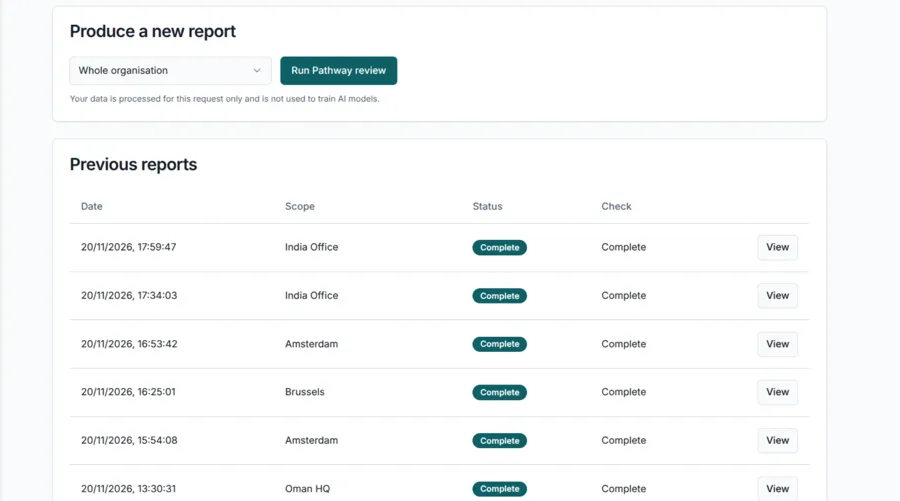
Every Pathway scan is logged with its date, scope and status, so the group holds a timestamped trail of what was reviewed and when.
The Three-Lines Model for Multi-Entity Oversight
Cross-border privacy governance fails when the person doing the work is also the person assuring it. The three-lines model separates those roles, which is what gives the Group DPO's assurance any credibility — internally and with a regulator.
First line — local entity management. The business owners who collect, process and share personal data. They maintain their own ROPA entries, run DPIAs for new processing and remediate findings in their own systems. They own the risk because they create it.
Second line — local privacy coordinators and the DPO office. They set the standards, provide templates and challenge the first line's submissions. They test whether a ROPA entry reflects reality, whether a lawful basis holds, whether a vendor assessment has evidence behind it. This is advisory and monitoring work, not execution.
Third line — Group DPO and internal or external audit. Independent oversight of whether the first two lines are functioning. The third line does not populate records or fix findings. It evaluates coverage, tests the quality of second-line challenge, and reports to the board.
The distinction matters most when the Group DPO is under pressure to help. A DPO who starts writing entity ROPA entries has quietly become the first line and can no longer independently assess that work. Keeping the separation intact requires a shared system where each line sees the same data with different permissions — the first line entering, the second line reviewing, the third line observing without editing.
Benchmarking Compliance Maturity Across the Group
Entities are not equally capable, and treating them as though they are wastes the group's attention. Maturity assessment describes how well an entity's privacy processes actually work, independently of how many findings it currently has. A small entity with a disciplined, repeatable process is a lower long-term risk than a large one that improvises each time.
Useful maturity bands, described rather than scored:
- Initial — activity happens, but reactively and without documented process. Outcomes depend on individuals.
- Repeatable — processes exist and are followed inconsistently across teams.
- Defined — processes are documented, owned and applied the same way across the entity.
- Managed — processes are monitored, with evidence retained and deviations investigated.
- Optimised — processes are reviewed and improved on a cycle, with lessons fed back to the group.
Resist the temptation to collapse these bands into a single number per entity, or worse, a group-wide percentage. One figure averages away precisely what the Group DPO needs: the entity that is strong on records but weak on breach response reads identically to one that is mediocre at both. A score invites management to chase the number, and numbers are easier to improve than practices.
Use maturity comparatively instead. Where one entity has built a working vendor review process, name it and transfer the method elsewhere. Where another repeatedly misses review windows, treat that pattern — not its current finding count — as the signal for group intervention.
Key Takeaways for Group Privacy Oversight
Summary of what group-wide privacy oversight requires
- Centralised visibility is the foundation of cross-border compliance. A Group DPO cannot assure what they cannot see, and consolidated spreadsheets describe a past state rather than a current one.
- Entity status must be stated in plain, consistent language across every subsidiary, with an explicit flag when a review has aged beyond its window. "Not reviewed" and "no findings" are entirely different conditions and should never appear alike on a report.
- Severity-based findings direct limited remediation capacity toward the highest-impact risks first, and each finding should state whether it rests on a legal obligation, regulator guidance, best practice or outstanding setup.
- Review coverage is a distinct metric from findings. An unassessed entity carries unquantified risk and belongs on the escalation path alongside open high-severity items.
- The three-lines model keeps the Group DPO independent. The first line owns and maintains the data, the second line challenges it, and the third line assures the whole system without editing any of it.
- Prioritised remediation with past-due tracking converts static audit output into active risk reduction, and the resulting timestamped record is what satisfies a regulator's question about what the group actually did.
- A single aggregate compliance score obscures more than it reveals. Entity-level detail, not a headline percentage, is what supports a defensible governance decision.
Visibility is what moves the Group DPO from reactive firefighting to proactive governance of global privacy health.
Operationalising Global Governance with Privacy360
Fragmentation poses a significant challenge. Records of processing sit in one entity's shared drive, assessments in another's email thread, vendor evidence in a third system, and AI systems nowhere at all. Each gap is defensible on its own. Together they make group-level assurance impossible.
Privacy360 serves as an enterprise command centre, centralising global data privacy and AI governance into a single operational platform. ROPA, privacy assessments, DSAR, breach management, vendor and contract review, consent, training and AI modules run in one place, with audit trails and regional jurisdiction handling built in rather than bolted on. The AI System Register documents, classifies and governs AI systems across the group, bringing EU AI Act obligations into the same workflow as GDPR — not into a parallel programme that nobody reconciles.
Embedded AI-assisted review aids multi-jurisdictional work while preserving human judgment. In the Natalie Pathway, defined Privacy360 rules produce the figures; AI explains what they mean and recommends the next step. The Group DPO still decides.
That is what audit-ready transparency looks like in operation: every finding traceable to a named record, every basis stated, every remediation timestamped, and no single score papering over an entity that has gone quiet.
Organisations with multi-entity, cross-border structures should evaluate this against their own entity map rather than in the abstract.
Book a demo for a guided walkthrough of Privacy360 built around enterprise and multi-entity rollouts.
Read more about Natalie Pathway, the Privacy360 Intelligence Centre, which gives Group DPOs this single view across every entity.
Frequently asked questions
What is a single view of global privacy compliance?
It is one place where a Group DPO sees every legal entity's live privacy status, open findings by severity, review coverage and the exact affected records, in the same language and kept current as work happens rather than at the end of a reporting cycle.
Why does review coverage matter as much as findings?
An entity with no findings and no completed reviews can look healthy on a report while being the highest risk in the group. Coverage shows which entities have actually been assessed and flags reviews that are out of date.
Why does Natalie Pathway not show a single compliance score?
One aggregate number hides the entity-level detail a Group DPO needs. Natalie Pathway shows status per entity, findings by severity and coverage instead, and a No findings status means the configured checks found nothing; it does not certify legal compliance.
How does the three-lines model apply to multi-entity privacy oversight?
Local entity management owns and maintains the data, local privacy coordinators and the DPO office challenge it, and the Group DPO with audit assures the whole system without editing records, which keeps group assurance independent.
Is Natalie Pathway an extra cost?
No. Natalie Pathway, the Privacy360 Intelligence Centre, is included in all Privacy360 plans at no additional cost.