DPIA Workflow Example for Enterprise Control
By Formiti Global DPO Team, Formiti Data International
A DPIA workflow example for enterprise teams: intake, screening, proportionate routes, cross-functional review, approval conditions and change management.
Topics: DPIA, Privacy Operations, Governance, AI Governance, GDPR
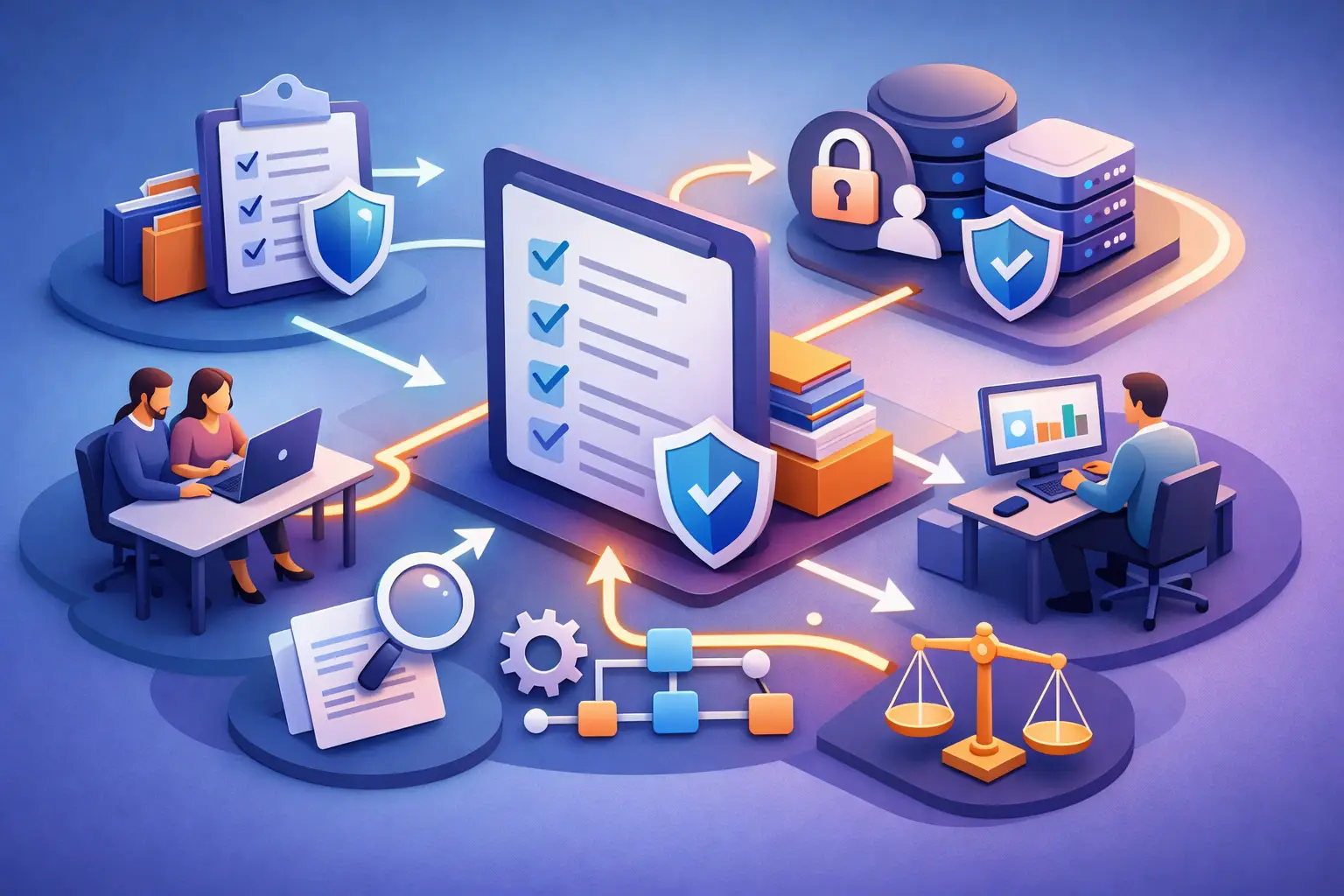
Putting this into practice? See how Privacy360's DPIA and privacy assessment software handles it. Run DPIAs, TIAs, LIAs and gap analyses across 150+ controls with tracked remediation.
A new customer analytics initiative is ready to move into delivery. It will combine transaction histories, call recordings and behavioural signals, use a third-party AI service, and support teams across the UK and EU. The project owner needs a decision quickly. A DPIA workflow example shows how to make that decision controlled rather than improvised: identify the risk, involve the right functions, set conditions for approval, and retain evidence that stands up to scrutiny.
For privacy leaders, the assessment itself is only one part of the task. The larger challenge is building a repeatable operating process that prevents high-risk processing from bypassing privacy review, while avoiding unnecessary delays for low-risk work.
What a DPIA workflow needs to control
A Data Protection Impact Assessment is required where planned processing is likely to result in a high risk to individuals' rights and freedoms. In practice, that threshold can involve large-scale monitoring, special category data, systematic profiling, vulnerable data subjects, new technology, or combinations of datasets that materially change the risk profile.
The workflow should therefore do more than present a questionnaire. It needs to control entry points, ownership, escalation, evidence, decisions and change management. If these elements sit in separate spreadsheets, inboxes and shared drives, it becomes difficult to prove which version was approved, whether agreed actions were completed, or whether a material change triggered reassessment.
A well-designed workflow has proportionate routes. Not every processing activity needs a full DPIA. A basic intake and screening decision may be sufficient for routine processing that is already covered by an established ROPA entry and approved controls. The full assessment route should activate when the screening indicates elevated risk or when internal policy requires review for defined activities, such as AI deployment or new international transfers.
DPIA workflow example: an AI-enabled analytics project
Consider an organisation introducing an AI-enabled customer service analytics platform. The platform will process call transcripts and customer account information to identify recurring service issues, flag potential vulnerability indicators, and score call quality. It will be used by customer operations, compliance and quality assurance teams across several jurisdictions.
This is not automatically unlawful or unmanageable. But it combines profiling, potentially sensitive inferences, a new supplier, cross-functional access and AI-supported decision-making. A disciplined DPIA workflow gives the organisation a reliable way to establish whether the proposed use can proceed and under what conditions.
1. Intake starts with the business owner
The business owner submits a structured intake before procurement is finalised or the technology is configured. The request should capture the purpose, affected individuals, data categories, jurisdictions, expected volumes, retention proposal, systems involved, suppliers and intended users.
The intake should also ask whether the solution makes or supports decisions about individuals, uses machine learning, draws inferences, monitors behaviour, or processes special category data. These questions are not administrative detail. They determine which governance routes must be connected to the assessment.
In this example, the owner identifies customer call recordings, transcripts, account data and inferred vulnerability signals. The request is automatically assigned a case owner in the privacy team, with the business sponsor accountable for supplying complete information.
2. Triage determines the right assessment path
The privacy reviewer assesses the intake against a documented DPIA threshold. The combination of systematic analysis of calls, inferred personal characteristics and AI-supported scoring means a full DPIA is required. The reviewer records the rationale, rather than simply marking the case as high risk.
At this point, connected workflows should be initiated where relevant. The processing activity requires a ROPA record or an update to an existing record. The supplier requires a vendor or third-party risk assessment, including security, sub-processing and international transfer review. If legitimate interests are proposed as the legal basis, a Legitimate Interest Assessment should be completed alongside the DPIA.
For an AI-enabled use case, the workflow should also create or update an AI system registry record. This establishes a single source of truth for the system owner, purpose, model provider, data sources, human oversight arrangements and applicable EU AI Act classification. A DPIA does not replace AI governance, and an AI classification does not replace the privacy assessment. They need to operate as connected controls.
3. The assessment documents the processing as it will operate
The project team, privacy lead, security stakeholder and supplier manager contribute evidence in their areas of responsibility. The DPIA should describe the real operating model, not the intended business benefit alone.
For this project, the assessment records how calls are collected, transcribed, transferred to the provider, analysed, viewed by internal teams and eventually deleted. It identifies whether raw audio is necessary or whether transcripts can meet the purpose. It establishes which teams can see vulnerability flags and whether a score can affect an individual's access to support, service or account treatment.
This stage should test necessity and proportionality. The right question is not merely whether the technology can analyse every call. It is whether analysing every call is necessary for the stated purpose, whether less intrusive sampling is viable, and whether the scope can be narrowed by excluding categories of calls or data fields.
The assessment should clearly link each purpose to a legal basis, retention period and transparency requirement. Where the organisation relies on legitimate interests, the LIA needs to show why those interests are legitimate, necessary and not overridden by the impact on individuals. Where consent, contract or legal obligation is relevant, the reasoning should be equally specific.
4. Risk analysis turns concerns into accountable actions
The team identifies risks to individuals before agreeing controls. In this example, risks may include inaccurate vulnerability inference, excessive monitoring of customers or staff, unauthorised access to transcripts, opaque use of automated scores, retention beyond business need and overseas transfer exposure.
Each risk receives an inherent rating, defined mitigations, a residual rating and a named action owner. This distinction matters. A security control might reduce the likelihood of unauthorised access, but it does not address whether broad call analysis is proportionate. Privacy, security, legal and operational controls need to be assessed against the risk they are designed to reduce.
The resulting action plan could require role-based access, transcript redaction, a shorter retention period, documented human review before any consequential action, updated privacy information, contractual restrictions on supplier model training, and a defined process for handling data subject rights requests. If the solution creates new data or inferences, the DSAR management process must be able to locate and review that information.
A control is not complete because it appears in the DPIA. The workflow should require evidence of completion, such as a signed data processing agreement, configuration confirmation, training record, revised retention schedule or tested access-control report. Open actions should remain visible to the accountable business owner and approver.
5. Approval is a decision gate, not a signature chase
Once contributors have completed their sections, the DPIA moves to approval. The approval route should reflect residual risk and the organisation's delegation model. A lower-risk assessment may be approved by the privacy lead and business owner. Higher-risk or strategically significant processing may need input from legal, security, risk, the DPO or an accountable executive.
In this example, approval is conditional. The project may proceed to a limited pilot only after the supplier assessment is complete, contractual terms prohibit secondary model training, and human review controls are demonstrated. Production deployment remains blocked until those conditions are evidenced.
Where residual high risk remains and the organisation cannot reduce it through reasonable measures, the workflow must escalate appropriately. Under GDPR, prior consultation with the relevant supervisory authority may be required before processing begins. The record should show why escalation was considered, the advice obtained and the resulting decision.
6. Post-approval monitoring keeps the DPIA current
A DPIA is not a one-time project document. The processing can change through a new data source, expanded user base, revised model capability, supplier sub-processor, international transfer, incident or change in purpose. Any of these may alter the original risk decision.
The workflow should set a review date based on risk, but event-driven reassessment is equally important. Procurement changes should notify the supplier review owner. Material system changes should prompt the AI registry and ROPA owner. A breach or near miss should link to the incident management process and trigger review of relevant controls.
This avoids a common failure point: a DPIA that was accurate at launch but no longer reflects the service in operation. Audit readiness depends on current, connected records, not a completed PDF stored in a project folder.
Build the workflow around accountability and evidence
A scalable process does not require a large privacy team to manually chase every contributor. It requires clear ownership, automated routing and a controlled record of decisions. The business owns the proposed processing. Privacy owns the assessment standard and risk challenge. Security, legal, procurement and AI governance teams provide accountable inputs within the same workflow.
Privacy360 brings these connected activities into one operational system, linking DPIAs with ROPA, LIAs, vendor assessments, AI system oversight, contract review, incident management and evidence collection. This reduces duplicate data entry while preserving the distinct approvals and controls each governance function requires.
Where internal capacity is limited, many organisations combine platform-led governance with external expertise. Formiti's data protection consulting services can support programme design, record quality reviews and multi-jurisdiction implementation alongside the platform.
The objective is not to create more assessment paperwork. It is to make every high-risk processing decision traceable, proportionate and actively managed long after the launch meeting has ended.