How to Choose and Implement AI Governance Solutions: A Practical Guide for 2026 Compliance
By Formiti Global DPO Team, Formiti Data International
Learn how to select and implement the right AI governance solutions for 2026. Build a scalable framework to manage risk, ensure compliance and deploy AI with confidence.
Topics: AI Governance, EU AI Act, Compliance, Risk Management, AI Regulation
Putting this into practice? See how Privacy360's AI governance software handles it. Govern AI systems end to end: register, assess, remediate and evidence under the EU AI Act.
Choosing AI Governance Solutions in 2026
Deploying AI systems without a structured AI governance framework isn't a risk management strategy — it's a liability accumulation strategy. Across large enterprises, cross-border legal entities and product-led organisations, AI is already embedded in vendor contracts, customer-facing decisions and internal workflows. The question isn't whether governance is needed; it's whether your current approach can prove, on demand, that every system was reviewed, classified and approved by someone accountable.
This guide is built for privacy, compliance, security and AI teams preparing for 2026 enforcement realities — particularly the EU AI Act's operational requirements and the growing due diligence demands arriving through procurement. It covers how to evaluate AI governance solutions against criteria that survive a real audit, how to implement controls that sit inside the development lifecycle rather than alongside it, and how to avoid the failure modes that turn signed policies into shelf documents.
Privacy360 approaches AI governance as an operational discipline, not a documentation exercise. That means structured workflows, shared evidence across DPIA and AI registers, and audit trails that assemble themselves from work already done — not from analysts reconstructing decisions after the fact.
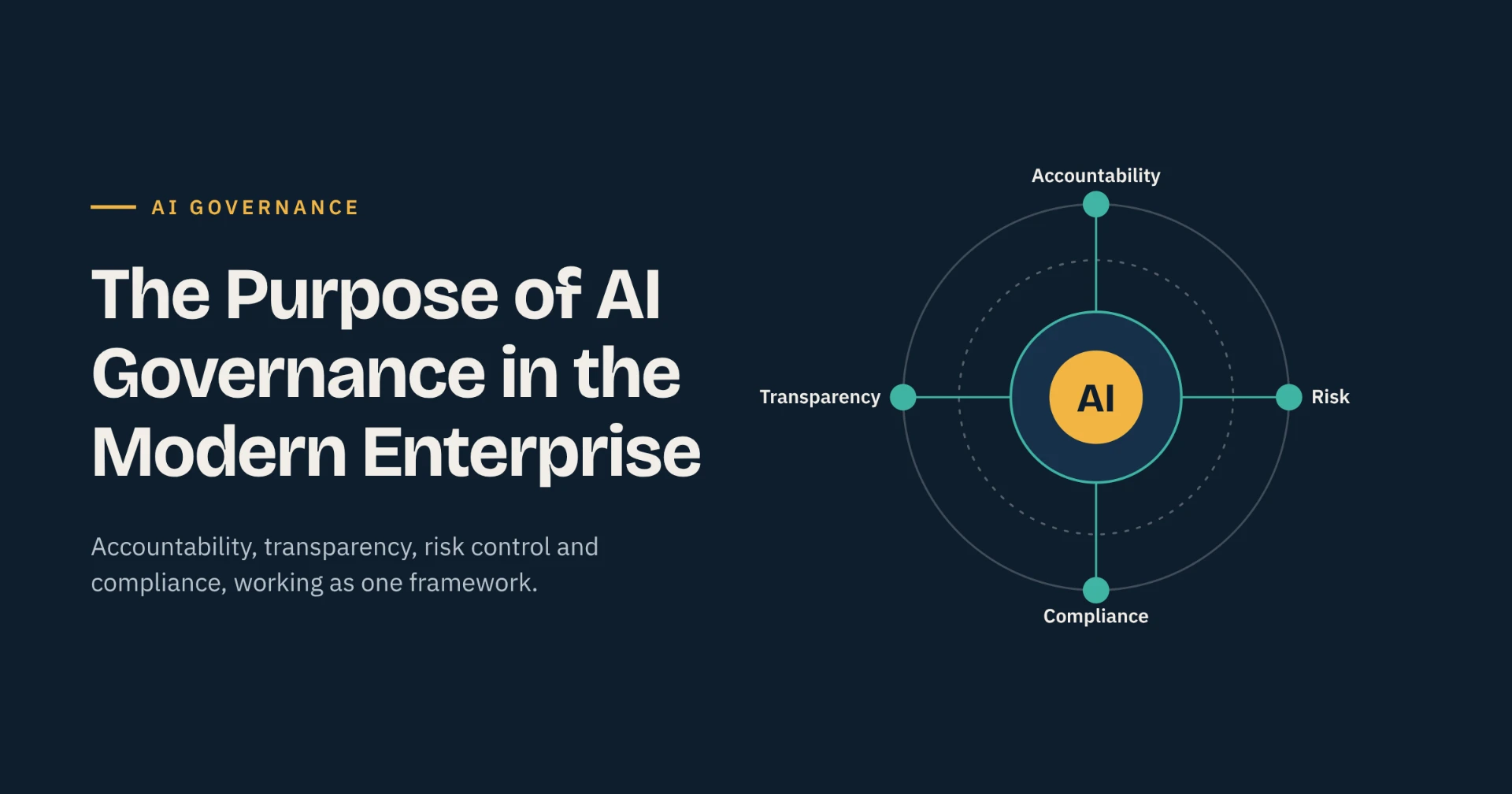
The Purpose of AI Governance in the Modern Enterprise
A retail compliance lead opens a vendor contract review and finds a scoring model already running against vendor contracts — deployed by a product team, documented nowhere, reviewed by no one. Nothing broke. That's the problem: nobody could prove it hadn't.
AI governance is the set of guardrails that lets an organisation deploy models without accumulating legal or reputational debt. Think of it as a braking system rather than a speed limit — reliable brakes are what make speed survivable. Trust is the currency of AI, and governance is the mechanism that mints it.
Effective AI governance solutions span the whole chain of accountability: boards setting risk appetite, legal teams interpreting obligations, privacy teams mapping data flows, and engineers implementing controls. Enterprise AI governance fails when any one of those links assumes another owns it.
Building Your AI Governance Strategy: Foundations and Frameworks
An AI governance strategy starts with a decision about oversight density: which automated decisions require a human reviewer before they take effect, and which can run unattended with sampling after the fact. Set that threshold deliberately rather than defaulting to engineering convenience.
A workable AI governance framework maps obligations under the EU AI Act to named owners across three lines of defence — product teams building, risk and compliance challenging, internal audit verifying. Responsible AI governance also demands written ethical guidelines covering automated decision-making and algorithmic transparency. An AI governance policy template is a useful starting skeleton, but it only becomes governance once each clause has an accountable name attached.
Essential Capabilities of Modern AI Governance Software
Credible AI governance software does four things well:
Inventory discovery. You cannot govern what you cannot see. The platform must surface every model, agent and embedded third-party feature operating across the estate, including those arriving through SaaS updates.
Automated documentation. Audit trails should assemble themselves from workflow activity, not from analysts retyping decisions into spreadsheets. Automated AI governance means evidence is a byproduct of work.
Risk scoring. Systems need classification by impact tier — prohibited, high-risk, limited-risk — with that classification driving which assessments trigger next.
Policy enforcement. Controls that block unapproved deployment at the gate, surfaced through an AI governance dashboard that shows status rather than requiring a status meeting.
Together these capabilities turn scattered AI governance tools into a single operating picture.
How to Evaluate and Compare AI Governance Platforms Against a Proven AI Governance Framework
Any serious AI governance platform comparison should test candidates against criteria that survive contact with a real audit:
- Integration depth. Does it connect to model registries, ticketing and vendor systems, or does it rely on manual uploads?
- Compliance coverage. Does the product handle multi-jurisdictional obligations, or is it EU AI Act compliance software with nothing to say about other regimes?
- Privacy and AI unification. Can records of processing, DPIAs and AI classifications share one evidence base?
- Cost control. Count implementation services and per-seat expansion, not just licence fees.
- Auditability. Can a third-party assessor reconstruct who decided what, and when?
Major audit firms have pushed AI assurance toward the documentation discipline already familiar from financial controls, which favours tools bridging policy and technical execution. The best AI governance tools now behave less like standalone AI compliance software and more like command centres.
Comparison Table: High-Level AI Governance Solution Types
| Solution type | Strengths | Trade-offs | Best for |
|---|---|---|---|
| Standalone AI risk management software | Deep model-level metrics, bias testing | Disconnected from privacy records | Data science-led organisations |
| Integrated privacy and AI governance platform | Shared evidence across DPIA, ROPA, AI register | Requires cross-team process alignment | Multi-entity, cross-border enterprises |
| Open-source monitoring stacks | Flexible, low licence cost | Engineering burden; weak audit output | Mature in-house ML platform teams |
| Legacy GRC suites | Broad control libraries | Slow deployment, generic AI coverage | Established enterprise risk programmes |
Standalone tools lean toward continuous AI governance monitoring; GRC suites lean toward point-in-time attestation. Regulated industries generally need both.
Technical Deep Dive: Integrating Governance into the AI Lifecycle
AI lifecycle governance works when controls sit inside the pipeline rather than alongside it. Integration points are predictable: the model registry, where version metadata and intended purpose are captured; the data pipeline, where lineage ties training inputs back to lawful basis and retention rules; and the deployment gate, where classification determines whether release proceeds.
Embedded review is the mechanism for high-stakes decisions. Instead of routing a case to a separate queue, the reviewer sees the decision, the inputs and the applicable obligation in one place, and the approval itself becomes the audit record.
Governance requirements vary by system class. Predictive scoring, recommendation engines, biometric systems, generative models and autonomous agents each carry distinct exposure, which is why AI model governance and AI model risk management need per-class control sets rather than one universal checklist.
Step-by-Step Implementation: Operationalising Your Command Centre
Phase 1 — Catalogue. Find shadow AI before regulators do. Survey teams, scan vendor contracts for embedded model clauses, and load findings into an AI System Register that records purpose, owner, data categories and deployment status. This inventory is the foundation every downstream control depends on — without it, your AI risk management software has nothing reliable to act on.
Phase 2 — Classify and test. Define thresholds that trigger an AI governance risk assessment, a DPIA or bias testing. Your AI risk management software should drive this classification automatically, routing high-risk systems to structured review and clearing low-risk ones without manual triage. Extend the same discipline to suppliers through a structured AI governance vendor assessment, since most AI exposure now arrives through procurement.
Phase 3 — Enforce. Configure alerts for drift, scope creep and unapproved deployment, with documented escalation paths and the authority to suspend a system. Enforcement is where governance becomes operational rather than aspirational — controls that don't block or escalate are observation, not oversight.
Phase 4 — Audit continuously. Replace annual review cycles with rolling evidence collection, so regulatory reporting is an export rather than a project. Privacy360 assembles audit trails from workflow activity already completed, meaning evidence is a byproduct of work done rather than a reconstruction effort. Sequencing matters more than speed in AI governance implementation — get the catalogue right before enforcing, and enforce before you report.
Common Failure Modes and How to Fix Them
The policy–execution gap. A signed AI policy that no deployment pipeline enforces is documentation, not control. Fix it by tying each policy clause to a system gate or workflow trigger.
Fragmented workflows. When data mapping lives in one tool and AI oversight in another, classifications drift apart. Unifying both under one record set keeps AI governance and compliance consistent.
Cross-border complexity. Entity structures, transfer mechanisms and residency expectations vary by market, and procurement teams increasingly ask where evidence is stored. Regional data residency architecture answers that question before it becomes an objection.
Governance fatigue. Reviewing every generative AI governance request at the same depth exhausts teams. Prioritise by impact tier and automate the low-risk path.
Limitations, Trade-offs and Considerations
Software operationalises judgment; it doesn't supply it. A platform can route a facial recognition proposal to the right reviewers and record the outcome, but deciding whether the use is acceptable remains a human responsibility — and a contested one.
There's a real trade-off between control and velocity. Heavier gates slow experimentation, and over-tuned governance pushes teams toward unmanaged tools, recreating the shadow AI problem the programme was meant to solve. Calibrate by risk tier, not uniformly.
Audit-ready is also not risk-free. Complete documentation proves a decision process existed; it does not prove the decision was correct, and it does not immunise against enforcement or litigation.
Finally, automation reduces manual effort without removing the need for qualified legal interpretation. AI governance consulting and in-house counsel remain necessary where obligations are ambiguous or newly tested.
The Bottom Line: Key Takeaways for 2026
Fragmented tooling often leads to AI compliance failures; a unified command centre is the solution. Governance should be integrated into the development lifecycle, not added at release. Audit-readiness — the ability to reconstruct any decision on demand — is a key measure of programme maturity. And the strongest programmes pair policy automation with human accountability, because trust is still earned one defensible decision at a time.
Where to Look Next
Track official regulatory guidance as implementing acts and national supervisory expectations develop. Follow standards bodies for technical benchmarks and conformity assessment criteria. Review peer-reviewed research on algorithmic bias and mitigation, which moves faster than regulation. Watch trade and transfer developments affecting cross-border AI deployment.
Next, pressure-test your own stack. Browse the Privacy360 modules or book a demo to see how privacy and AI governance operate from one audit-ready workspace.
Common questions
- Why is AI governance a priority for enterprises now?
- Enforcement timelines under the EU AI Act, supply-chain due diligence demands and board-level scrutiny have converged on the same requirement: provable oversight of every AI system in use.
- What suits regulated industries?
- Platforms that unify privacy records with AI registers, support multi-jurisdiction obligations and produce exportable evidence. Buyers often evaluate NIST AI governance and ISO 42001 alignment side by side.
- Does the EU AI Act affect US organisations?
- Yes, where systems or outputs reach EU users, or where EU customers impose contractual obligations that flow down through procurement.
- What does embedded AI do in compliance workflows?
- It drafts assessments, flags gaps and accelerates review, while a named human approves the outcome and remains accountable for it.