AI Risk Register Review That Holds Up
By Formiti Global DPO Team, Formiti Data International
An AI risk register review that holds up: minimum standards, connected evidence, EU AI Act alignment and a cadence that keeps it a live record.
Topics: AI Governance, AI Risk Register, EU AI Act, Privacy Operations, ISO 42001
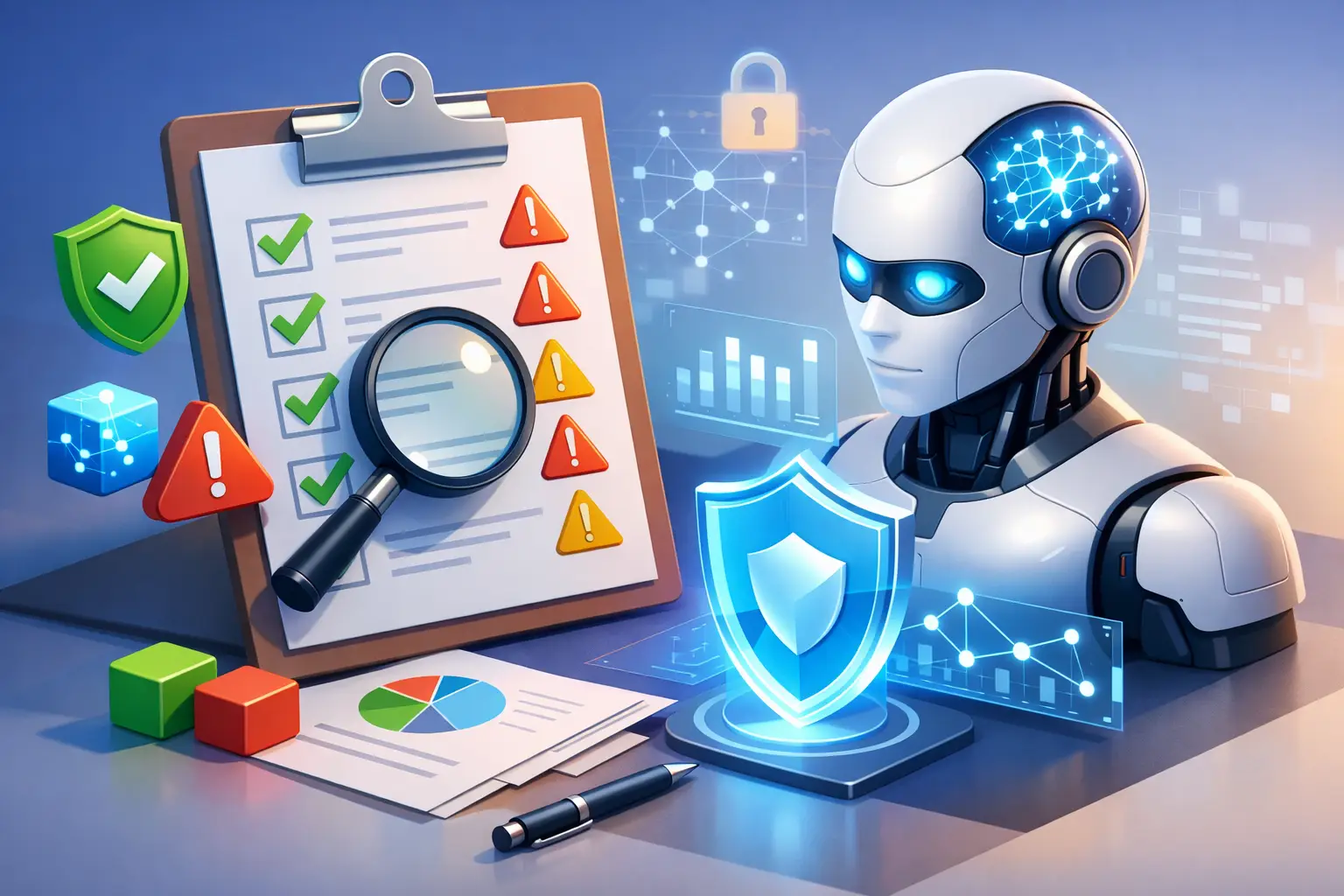
Most AI risk registers look acceptable until someone asks a simple question: who reviewed this risk, when, and what changed after the review? That is where an ai risk register review stops being an administrative task and becomes a governance control.
For privacy, legal, compliance, and risk leaders, the issue is not whether a register exists. It is whether the register still reflects how AI systems are actually being used across the business, whether controls are current, and whether accountability can be evidenced under audit, board scrutiny, or regulatory enquiry. A stale register gives a false sense of control. A reviewed register gives management something they can rely on.
What an AI risk register review is really checking
A review is not just a pass through existing entries for spelling, format, or completeness. It is a structured challenge to whether the register still represents the organisation's current AI estate, real operational risks, and active mitigation measures.
That means checking whether new AI use cases have entered the business without formal onboarding, whether risk ratings still match present deployment conditions, and whether control owners have delivered what the register says they have delivered. It also means looking for the opposite problem: legacy risks that remain on the register long after the underlying system, process, or supplier has changed.
An effective review tests the relationship between the register and the surrounding governance process. If the register says a system is low risk, there should be supporting evidence in the assessment record, supplier file, incident log, and decision trail. If those records are disconnected, the risk register is operating as a standalone document rather than part of a control system.
Why AI risk register review often fails in practice
The common failure mode is fragmentation. One team logs the AI use case, another performs a privacy assessment, procurement reviews the supplier, security records technical issues elsewhere, and legal tracks contractual obligations in a separate workflow. The register then becomes a manually updated summary of data held in five other places.
That model breaks down quickly. Reviews become periodic clean-up exercises rather than continuous oversight. Risk ratings drift. Owners change roles. Mitigations are marked complete without evidence. In larger organisations, different business units may classify similar systems differently because there is no common review discipline.
There is also a timing problem. AI risks do not stay still. A model may be introduced for internal productivity and later used in customer-facing processes. A supplier may add new functionality. Personal data usage may expand beyond the original scope. If review cycles are driven only by annual compliance calendars, the register can lag behind actual exposure.
The minimum standard for a defensible review
A defensible AI risk register review should answer five operational questions.
First, does the register include the full inventory of relevant AI systems and use cases? If the organisation has no reliable AI system registry, the review starts with an incomplete population. That weakens every downstream control.
Second, are risks described in a way that supports action? Vague entries such as "bias risk" or "privacy concern" are not enough. Risks should connect to a real context: which system, what decision or output, which data, which affected group, and what business impact.
Third, are ratings based on current facts rather than historic assumptions? The review should revisit likelihood and impact using the latest deployment scope, user population, supplier dependencies, and control environment.
Fourth, is ownership clear? A risk without an accountable owner is effectively unmanaged. Reviewers should be able to identify who owns the risk, who owns the mitigation, and who signs off residual risk.
Fifth, is there evidence? If the register records that human oversight, testing, contractual controls, or incident response measures exist, the reviewer should be able to trace those claims to supporting artefacts.
How to structure the review without creating more overhead
The strongest review processes do not treat the register as a separate governance object. They use connected workflows so that review activity pulls from the operational records already maintained elsewhere.
For example, if a new AI use case has gone through a DPIA or related assessment, the review should use that output rather than ask teams to restate the same facts in a spreadsheet. If a vendor handling model services has undergone third-party risk assessment or contract review, those records should inform supplier-related entries in the AI risk register. If an incident has been logged involving model output, data leakage, or unauthorised use, that incident should trigger reassessment of the relevant risk entry.
This is where an operational platform matters. A connected approach allows the review to test consistency across records instead of relying on manual reconciliation. It also shortens the review cycle because reviewers are validating linked evidence, not rebuilding context each time. Where teams need external challenge or an independent review, Formiti's AI governance consulting services provide senior practitioner support for register reviews, EU AI Act readiness and ISO 42001 alignment.
What should change after an AI risk register review
A good review produces decisions, not just annotations. Some risks will need re-rating. Some systems will need escalation for further assessment. Some entries will be retired because the use case no longer exists or the system has materially changed. In some cases, the review should expose that the organisation has been using an AI capability outside approved governance pathways.
That last point matters. Review should be capable of surfacing shadow AI, unmanaged supplier dependencies, or business-led deployments that entered production before legal, privacy, or security review. If the process cannot identify those cases, it is too passive.
Not every change requires the same response. A minor adjustment to wording may be enough where controls remain sound. A change in data category, purpose, model provider, or user impact may justify a fresh assessment and management sign-off. The right threshold depends on the organisation's risk framework and regulatory exposure, but the principle is consistent: review should lead to proportionate governance action.
AI risk register review under the EU AI Act and privacy obligations
For organisations operating across the EU, UK, and other regulated jurisdictions, review discipline is increasingly tied to demonstrable governance maturity. The EU AI Act raises the bar for structured oversight of AI systems, especially where risk classification, monitoring, documentation, and accountability are concerned. Even where a particular use case falls outside the highest-risk categories, weak register management can still indicate weak governance.
Privacy obligations create similar pressure. If personal data is involved, the AI risk register should not drift away from the organisation's processing records, impact assessments, legitimate interest analysis, supplier controls, and incident records. Review is the checkpoint that keeps those components aligned.
This is why many teams now treat AI governance and privacy governance as connected operational disciplines rather than separate programmes. The overlap is practical: the same use case can raise issues around lawful basis, transparency, vendor management, data minimisation, accuracy, explainability, security, and human oversight. A disconnected review process misses that reality. For organisations building or maturing this joined-up model, Formiti consulting services can support framework design, gap analysis and outsourced DPO or AI governance lead capacity.
Signs your current review process needs attention
If reviewers spend most of their time chasing updates by email, the process is already too manual. If no one can say which register entries changed since the last review, version control is weak. If the register contains risks for systems that are no longer in use, governance records are not being maintained as live operational assets.
Another warning sign is when review outcomes cannot be traced to action. If risks are re-rated but no assessment is reopened, no owner is notified, and no evidence is attached, the review has little control value. The same is true when AI records sit outside the organisation's wider compliance infrastructure.
For many teams, the answer is not to review less often. It is to make each review more systemised. Privacy360 supports this model by bringing AI system oversight, impact assessments, ROPA, vendor assessment, incident management, contract review, and evidence collection into one operational environment. That matters because AI risk register review works best when the register is part of the workflow, not a detached reporting sheet.
The review cadence that works in real organisations
There is no single correct timetable. High-impact or externally facing AI systems may need frequent review, especially where models, suppliers, or processing patterns change quickly. Lower-risk internal tools may suit a lighter schedule, provided there are triggers for reassessment when material changes occur.
The practical approach is a mixed model: scheduled reviews combined with event-driven reviews. Scheduled reviews maintain baseline discipline. Event-driven reviews respond to incidents, supplier changes, new data use, regulatory updates, or material changes in system purpose. This keeps governance proportionate without relying on constant manual checking.
What matters most is that the cadence is linked to operational reality. A quarterly review of an unchanged low-impact tool may be excessive. An annual review of a rapidly evolving customer-facing AI process may be far too slow. The right answer depends on exposure, criticality, and change velocity.
An AI risk register only becomes useful when it can support decisions with current evidence. Review is the mechanism that turns a static list into a live governance record. If the register cannot show what changed, who acted, and why the current risk position is acceptable, it is not giving the business control - only paperwork.